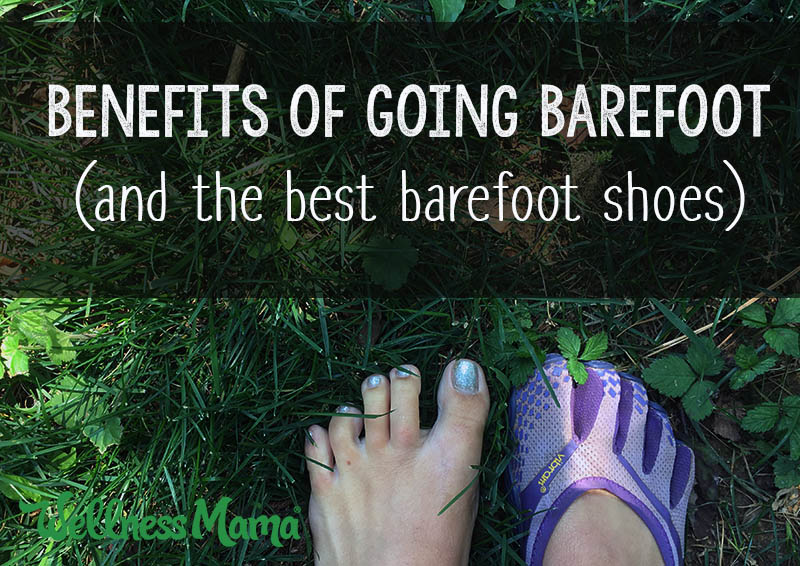
Now that warm weather is here, our family is spending a lot of time outside in the sun… and barefoot.
The benefits of getting outside are well-documented, but the barefoot part is often met with more skepticism. In a world where people are being diagnosed with “text neck syndrome” for spending too much time looking at a phone, it is funny to realize that many of us think that going *without* shoes is unnatural.
Benefits of Going Barefoot
Walking barefoot benefits the body in various ways. Think about it logically- feet weren’t designed to be in shoes, especially not the stiff and highly-restraining shoes we have today. Walking around barefoot (or as close as possible) may have quite a few impressive benefits:
Support the Body’s Natural Feedback Systems
Biomechanist Katy Bowman (and upcoming Healthy Moms Podcast guest) from Nutritious Movement claims that our modern shoes are contributing to a lot of problems including osteoarthritis, osteoporosis, knee-hip-back pain, and bunions. This is partially because most shoes block full motion of the foot joints and nerve feedback from the feet.
She explains:
There are nerves that interpret the shape of the ground by how the bones in the feet bend at 33 different points (joints). This creates a mental image in the brain (similar to how a dolphin uses sonar to avoid obstacles). Wearing shoes prevents any motion in these joints (except the ankle) and leaves the shoe-wearer “blind” to the environment. This is what makes stiff shoes the worst when it comes to natural development.
This is a large part of the reason that some neurologists recommend flat shoes, like swim shoes, for children with certain neurological delays. Wearing shoes with less padding improves the feedback from the feet and helps improve walking in these children.
Strengthen Feet & Legs to Avoid Injury
Most of us wear cushioned, supportive shoes with a positive heel. A positive heel means that the heel of the shoe is higher than the toe. Typically, the dressier the shoe, the more noticeable the positive heel (especially for women) and the more “athletic” the shoe, the more cushioned.
Heels and supportive running shoes are the norm, but some experts speculate that they may cause more harm that good!
Cushioned running shoes, which date back only to the 1970s, may seem comfortable but may actually contribute to foot injuries, say Daniel Lieberman, PhD, professor of human evolutionary biology at Harvard University, and colleagues.
Supportive and cushioned shoes encourage the wearer to land on the heel of the foot when walking or running, as the shoe absorbs the impact. This alters the natural step and posture and creates a different walking pattern. Watch babies who have just learned how to walk to see the difference!
It also limits our natural movement patterns and causes our muscles and range of motion to atrophy over time. Watch a baby or small child squat down and try to imitate it. Children can squat with butt to heels while maintaining a neutral spine. Most adults can’t.
Many factors contribute to this (sitting too much, not moving enough, etc.), but shoes play a big role.
Learn to Run Naturally Again
The book Born to Run popularized the idea of barefoot running as the author, Christopher McDougall, chronicles his search for pain free running and how he found a primitive tribe that ran great distances barefoot or in minimalist sandals.
As The Art of Manliness explains:
The publication of the book coincided with a Harvard study by Prof. Dan Lieberman, which showed that people who grow up running without shoes run differently than those of us who run shod. Though the study did not speculate as to whether barefoot running was better or worse than running in shoes, it did demonstrate that making the switch resulted in softer landings and reduced impact force.
In other words, running/walking barefoot or in barefoot-type shoes may be an easy way to improve walking posture. It may even help avoid joint problems.
It is important to note that barefoot and barefoot shoes showed different results when studied. The feet don’t get the same feedback while wearing any shoes. This is why experts don’t recommend running on hard pavement with barefoot style shoes.
Benefit the Brain?
Katy Bowman also explains that nerves in the feet are designed to sense temperature and terrain. This feedback helps us develop a proper gait and stabilization. When all our feet get to sense is the inside of these shoes, this process is put on auto-pilot.
Bowman explains that the body then moves this information to a part of the nervous system called the inter-neuron. Here’s how she explains it:
More about the inter-neuron: You know how when you walk into a room with a fresh baked pie, it smells delicious, but after a few minutes you don’t smell it anymore? Your brain moves information that is constant into a different part of your brain to free it up for other things, so the more similar your environment, the less your nerves work to perceive. And the less they work, the less healthy they are.
Isn’t Being Barefoot Dangerous?
There are two main concerns with going barefoot:
- Lack of arch support
- Potential for parasites
I don’t worry about these personally, because:
Lack of Arch Support
This is a touchy subject, especially as rates of foot pain increase. Many people now wear orthotics and extra support for the feet. Movement specialists like Bowman feel that this could be making the problem worse.
The reasoning is that the feet weren’t designed to have as much support as modern shoes provide. Our feet are so supported in most shoes that we don’t have to use the muscles of the feet in the same way. Over time, the muscles weaken which may cause the problem.
As with any muscle, we have to actually use it to strengthen it. Foot pain without arch support may just be a sign of weak foot muscles that need to get stronger. Incorporating more barefoot movement (or wearing barefoot style shoes) may help strengthen the feet over time.
A podiatrist friend cautioned that they often see injuries when a person makes too fast of a switch from highly supportive shoes to barefoot or barefoot shoes. Like any type of exercise, we should start slowly and work up. Running in mini-mattresses of shoes one day and in zero-drop shoes the next is a recipe for disaster.
Potential for Parasites
When I mention that my kids don’t wear shoes in our yard, I typically get at least a few responses along the lines of: “I’d prefer not to let my kids get parasites from being barefoot, thank you very much.”
A quick search for the risks of parasites from going barefoot will have you convinced that we will all die from horrible parasites and diseases if any of us go barefoot. Except that the data doesn’t back this up.
If you are reading this, you likely live in a first-world country. You likely have indoor plumbing and bathe once in a while. Hookworms and other parasites were common when the majority of us didn’t have indoor plumbing. Human feces were often disposed of in yards, gardens, etc. Since hookworms can be easily transmitted through human excrement, they were much more common.
Improved hygiene and laws/codes prohibiting the open disposal of human feces has greatly reduced this problem. Even Dr. Lauren Ploch, a dermatologist who is very anti-barefoot admits that she has never treated a case of hookworm in the US.
Then again, some researchers are looking at purposefully ingesting hookworms to help reduce allergies and asthma. Interested to see where the research ends up on this one!
Viruses and Bacteria
Walking barefoot also exposes feet to potential viruses and bacteria. I don’t worry about the potential small risks for these minor and treatable problems. But then, I also think regular dirt exposure is important! Our family has never experienced any problems from spending time barefoot in our yard and other safe areas.
I consider the potential problems from wearing over-supportive shoes much more worrisome. Of course, with anything, do your own research and make sure you feel comfortable with whatever option you choose!
For those who aren’t comfortable with being completely barefoot, new minimalist and barefoot shoes are the best of both worlds. These are also great for everyday use in places where shoes are needed.
Barefoot Shoes: a Healthy Compromise?
In my opinion, being barefoot is the best when possible. When that isn’t an option, there are some great barefoot shoes that provide almost the same benefits. In general, shoes can be considered “barefoot shoes” if they:
- Do not have a raised heel. The shoe should be flat and all the same thickness from heel to toe.
- Allow free movement of the toes. Many shoes have thin or even pointy toe beds and constrain the toes. A barefoot shoe should be open or allow free toe movement.
In other words, barefoot shoes provide a basic protective barrier between the foot and the ground and not much else. Barefoot shoes also qualify as minimalist shoes, though not all minimalist shoes are technically barefoot shoes.
My Favorite Barefoot Shoes
There aren’t many shoes that qualify as true barefoot shoes. Minimalist shoes are another great alternative in cooler weather or for occasions that require them. Here are the barefoot shoes that our family uses:
Vivo Barefoot
One of my favorite brands. They also make a lot of great minimalist shoe options including sneakers, water shoes and dress shoes. For a true barefoot shoe, their Eclipse model is great. I’ve found them on Amazon here, or also on the Vivo Barefoot website.
Earth Runners
Most shoe stores don’t carry barefoot style shoes so often we have to buy without knowing if the size is right. Earth Runners has a great sizing system and also a custom option that is great for wide or narrow feet or to make sure sizing is perfect.
Five Fingers
Five fingers are the most protective of the barefoot shoes we use. These fit the foot like a glove and often get some interesting looks in public. These are the go-to barefoot shoes of fitness experts like Mark Sisson. I often travel in these because they are comfortable but protect the feet from truly gross places… like airports!
Robeez
None of the above options are great for babies and toddlers. I’m especially careful to let little ones walk barefoot whenever possible so they can develop good walking patterns. Thankfully, walking barefoot is a little more socially acceptable before age 2 or so! When going barefoot isn’t allowed, I put babies in Robeez (or similar) shoes as long as possible.
Important Notes on Barefoot Running
Being barefoot is great. Running barefoot on pavement may not be, at least without proper training!
Before I tried barefoot running, I consulted a friend who is a physical therapist about the safety of it and any possible problems.
He explained that when barefoot running is done correctly and worked up to slowly, it can be safe, but that many people jump in and begin running the same way they’ve always run, just without shoes, and that this causes problems.
Foot Strike Matters
From what he explained, the foot strikes the ground differently when shoes are worn. With shoes, a person is more likely to heel strike, or let the heel touch the ground first (unless the person has specifically trained not to run this way). Without shoes, landing in a heel strike can be damaging to the foot, especially over time, and it is much better to land on the mid-foot or top of the foot.
If a person tries to run with a heel strike in minimalist shoes or barefoot, this is likely to cause discomfort or even injury as the full impact of the strike is absorbed in the heel and transferred up the leg. Landing in a mid-foot strike allows for a more gentle impact and reduces this risk.
Work up Slowly
Even if a person begins running with a mid-foot strike when switching to minimalist shoes or barefoot options, the process uses the muscles of the foot and leg differently, and should be worked up to slowly. I speak from experience on this one, as my first day running in five-fingers, I pushed too hard and ended up with really sore calves for about a week.
The benefits of running barefoot or in minimalist shoes is that it naturally leads to a shorter stride, which means a lower impact on the feet and legs, and that it leads to landing with a slightly flatter foot, which may also help reduce injury.
Learn to Run Correctly First
The podiatrist’s suggestion? Learn to run the right way before trying to run barefoot. Even if you don’t plan to run barefoot, there may be benefits to learning to run like you are. A mid-foot strike is gentler on the feet and legs and may reduce the chance of injury.
If you heel strike like I did, I found it helpful to practice on nice soft grass or sand and focusing on landing mid-foot. This brought back memories of running around the backyard barefoot as a kid. When running this way, the heel still hits the ground, just not before the ball of your foot does (many people make this mistake, never let their heels touch, get really sore calves, possible achilles tendon issues, and swear off barefoot/minimalist running for life).
Smaller Steps
Another thing to focus on is increasing turnover. This means taking smaller steps but moving the legs more quickly. Instead of extending the foot in front of the body to propel forward, I focused on just leaning my body slightly forward to propel myself and “catching” myself during a controlled forward fall.
For running, I also found some type of barefoot shoe helpful. As much as I love walking around barefoot in the grass, this wasn’t doable on concrete or harder surfaces, and minimalist shoes like five-fingers protect my feet but allow me to work on my running technique.
Do you spend any time barefoot? Ever tried barefoot shoes? Share below!
Continue Reading...Benefits of Going Barefoot (and the Best Barefoot Shoes)
from Blog – Wellness Mama® https://wellnessmama.com/4918/barefoot-shoes/
via
SEO Derby