Showing posts with label Blog – Precision Nutrition. Show all posts

Thursday, 12 November 2020

Precision Nutrition Certification Grads: Spotlight on Christina Relke

When COVID hit and her gym closed in the spring of 2020, Christina Relke initially thought she’d just been given a vacation. She happily reacquainted herself with her couch, the remote, and everything Netflix had to offer.

“I thought I’d just go home, figure things out, and then go back to work,” says Relke, BA, CPTN, PN2, FMS, a Mississauga, Ontario-based personal trainer and nutrition coach.

But two weeks became four, then six.

With her savings dwindling and the virus proving anything but predictable, Relke pivoted—to launching an online coaching business. 

She faced a series of obstacles.

Fear nagged at her.

The increased foot traffic of the gym had brought clients to Relke, somewhat effortlessly. Outside of the gym, how would she get the word out?

Could she even train people online? How would she correct someone’s form or pick up on a clients’ nonverbal cues… through a computer screen?

And could she teach herself a range of new skills—say video production or social media marketing—in mere weeks?

Despite those challenges, over the course of just a few months, Relke built a solid business.

Precision Nutriton Grad and Nutriton Coach, Christina Relke .

Given that so many nutrition coaches and personal trainers are facing the same challenges, we wanted to know more. So we asked Relke:

If you’re exploring nutrition coaching as a career, her answers might help you determine if a nutrition certification is right for you. And if you’re already coaching, Relke’s experiences and advice could give you lots of ideas for growing your business.

Why did you become a certified nutrition coach?

As a certified personal trainer at a gym, one problem kept dogging Relke.

“People had the perception that I was a one-stop shop,” she says.

Sure, they posed questions one might expect:

  • What’s the best training program for weight loss?
  • How can I do squats without hurting my knees?
  • What’s more important: weights or cardio?

But they also voiced lots of other concerns, especially about food.

“I felt uncomfortable answering their nutrition questions,” Relke says. “I realized I was out of my scope.”

Initially, Relke thought the only solution was to go back to school, study nutrition, and complete the internship, exams, and licensure to become a registered dietitian.

But then she connected with a former classmate who suggested she look into a nutrition coaching certification.

Why did you choose Precision Nutrition as your nutrition certification program?

The former classmate that we mentioned above? He was Jeremy Fernandes, PN2, a coach at Precision Nutrition.

“He’s someone I respect,” says Relke.

Fernandes explained that, as a nutrition coach, Relke wouldn’t be able to offer medical nutrition therapy or give people meal plans, as registered dietitians did. But she would be able to have the conversations she wanted to have with her clients. (For more about what nutrition coaches can and can’t say, read “Can coaches give nutrition advice?”)

Plus, back in university, Relke’s focus was psychology. “The PN Certification will help you to apply what you learned for your degree,” Fernandes pointed out.

“I’m a sucker for figuring out why people do the things they do,” says Relke.

As soon as Fernandes explained Precision Nutrition’s heavy emphasis on change psychology, she was sold.

How did getting the nutrition certification impact your career and life? How did your income change?

After earning her Precision Nutrition Level 1 Certification in 2017 and PN Level 2 Certification in 2018, Relke changed how she worked with clients.

“Not only did those certifications improve my confidence, they added credibility to everything I said between sets, especially in relation to food and nutrition,” she says.

The two certifications also helped her do something powerful: Explain complicated nutrition and exercise topics in a way folks could quickly grasp.

As a result, more clients requested her and told other people about her, allowing her roster to grow. And grow. And grow.

Her ability to explain complex topics eventually earned her a promotion at the gym where she worked—to metabolic specialist, a managerial position that came with a team to oversee and a pay bump.

(To learn how much of a pay boost tends to come with a new nutrition certification, read: How much should you charge?)

“I don’t think I would have gotten the position had it not been for the nutrition certification—and I can say that confidently,” Relke says. “Not only could I administer metabolic testing, but I could explain the results to clients in a way they could understand.”

Then March 2020 came—along with COVID.

Her gym closed, and Relke was furloughed.

How did your nutrition coaching certification help you rebuild your career after COVID?

Relke now faced a daunting goal: Build on online business from zero clients to somewhere between 25 to 30 regulars.

Thankfully, she had access to a huge group of helpers: Her Precision Nutrition Certification gave her lifetime access to a Facebook community of more than 45,000 nutrition coaches (and counting), many of whom have experience with online coaching.

Based on what she learned, she decided to build her business using the following steps, which you could try to.

Step 1: Understand your superpower.

Remember earlier when Relke mentioned she was “a sucker for figuring out why people do the things that they do”?

That deep curiosity drove her to lean into her background in psychology and behavior change. She decided to create a coaching business focused on individually-tailored programs—paying as much attention to clients’ emotions and behaviors as to their form, reps, and sets.

“That’s my biggest strength,” she says.

Step 2: Define your ideal client.

Rather than throwing a big net and working with anyone who surfaced, Relke decided to specifically zero in on people with simple goals, such as feeling and looking better.

At Precision Nutrition, we call these Level 1 clients. They’re people who need support with the fundamentals, such as eating without distractions, getting enough sleep, or consuming more veggies and other whole foods consistently. (To learn more, check out Food Secrets That Change Lives, our essential guide to helping anyone eat better.)

If you’re thinking that describes just about everyone, you’re right. Level 1 clients make up about 90 percent of the population.

Step 3: Plan and build the business.

Relke found software that allowed her to host video chats, on-demand workouts, and more. Then she nailed down the services she would offer, how she would offer them, what she thought they were worth, and how she would market them.

Step 4: Learn from others.

At the gym, Relke had mostly trained, coached, and mentored staff.

Now, she suddenly felt like she needed to become an expert in a wide range of topics: marketing, business development, and the list goes on. So she studied successful companies (including Precision Nutrition), connected with top online coaches, and signed up for a number of virtual workshops and seminars.

You can study the “PN business formula,” too, with our FREE 5-day course: How to Succeed in Health and Fitness. (It was created by our co-founder, Dr. John Berardi.)

Step 5: Tell the world.

In August 2020, with her business plan, website, and social profiles in place, Relke started advertising online.

After about eight weeks, she’d already racked up 20 clients—two thirds of the way to her goal.

What kind of health and fitness work are you doing now, as an online coach?

Relke offers virtual nutrition coaching and personal training, working with clients one-on-one as well as in groups.

She occasionally partners with chefs, registered dietitians, and other professionals to offer group seminars and challenges.

Her clients include a wide range of people, such as:

  • a new mom who’s trying to get back to her pre-pregnancy body
  • a single dad who wants help pushing the intensity of his workouts
  • a nurse who runs triathlons for fun
  • a busy small business owner who needs help squeezing in fitness
  • a young professional who started drinking soda during the pandemic—and wants to get back to water

Though her clients vary in age, profession, and surrounding circumstances, one thing links them all together:

They’re learning to adjust—to home workouts, 24-7 parenting, home schooling, uncertainty, upheaval, and a slew of other new stressors.  

How does online nutrition coaching compare to coaching in a gym setting?

In the gym, Relke loved working closely with clients.

“I like getting in there, poking and prodding,” she says.

Not only did the close, personal interaction help Relke correct form, it also allowed her pick up on subtle body language cues. A blank expression might reveal that a client wasn’t into high-intensity workouts, for example.

Another plus: She didn’t have to put much effort into marketing. It seemed like every time she taught a Pilates class, her personal training roster grew.

Relke saw as many as 10 clients a day, taught classes, and ran nutrition seminars. On top of that, in a typical week, she spent up to 7 hours in meetings or organizing professional development opportunities for her staff.

“I often found myself scheduled back-to-back, so finding half an hour to catch my breath was rare,” she says.

Like many gym-based fitness professionals, Relke worked a range of hours—some shifts starting at 7 a.m. and lasting until 9 p.m., with a several hour break in the afternoon. During that break, she went home to walk her dog, answer work emails, or nap.

“You would think that I’d want to work out during that time but I was averaging three to five hours of sleep at night,” she says. “I was just so tired that I wanted to sleep.” (If you’re feeling the same way, read: How to transform your sleep.)

The pace left her drained, something she didn’t fully comprehend until after the gym closed.

With online coaching, Relke’s in control of her schedule. By keeping her client roster below 30, she’s able to cap sessions at 4 to 6 per day. This opens up time for other tasks, such as continuing education as well as dog walking, reading, and exercise.

“I was nervous about switching from in-person training to an online business,” Relke says. “I worried my quality of work would suffer. I thought I needed to be next to people as they were working out. Now I’m seeing that they don’t need me to hold their hands. That allows me to have lengthier discussions and to maintain personalized programming.”

A Typical Day of Online Coaching

7 a.m. to 9 a.m.

Relke schedules this time for herself.

She takes her husky, Jenney, for a long walk, has breakfast, reads or watches videos, meditates, and stretches.

9 a.m. to 11 a.m.

Relke reserves this time for backend business tasks, which include:

  • Responding to client messages.
  • Creating short marketing videos
  • Taking classes in business development, video production, SEO, and more
  • Crafting content for social media
  • Prepping for seminars

11 a.m. to Noon

She has a leisurely lunch and takes Jenney for walk #2.

1 p.m. to 4 p.m.

During the afternoon, Relke meets with clients virtually, either one-on-one or as a group.

Though each client meeting lasts 30 minutes, Relke books clients an hour apart. That gives her a cushion, so it’s no biggie if a client meeting runs long. The 30 minutes of unscheduled time also allows her to complete any needed post-session tasks, like sending follow-up materials or tinkering with client programs. Plus she can take a breather, if needed, as well as prepare for the next session.

4 p.m. to 5 p.m.

Now it’s time for walk #3 with Jenney, which serves as Relke’s warm up for her own strength training or mat Pilates session.

5 p.m. to 7 p.m.

Relke spends this time following up with clients, building her social media presence, reading and filing intake forms, answering messages, and building client programs.

7 p.m. to 10 p.m.

If she’s not running a virtual seminar or group workout, it’s dinner and relaxation time with her boyfriend and Jenney.

10-10:30
Bedtime

What’s your favorite part?

In a word: autonomy.

“There’s a freedom to running my own business,” she says. “I love being an entrepreneur and being able to assert myself and coach in a way that resonates with my values.”

A big part of those values: coaching holistically.

Holistic coaching involves taking the whole person into account, homing in on the decisions behind their food and lifestyle choices, and tailoring practices to their individual needs.

In addition to talking to clients about food and recipes, for example, Relke  highlights other topics, ranging from sleep to stress to relationships and more.

This whole-person approach allows Relke to blend her undergraduate degree in psychology with her post-college certification studies in nutrition and fitness.

“Holistic thinking is part of who I am as a professional,” she says.

What’s your advice for folks hoping to get certified and break into online nutrition coaching?

Earlier in this story, Relke outlined the five steps she followed to go from zero online clients to 20 in just a couple of months. Beyond that five-step formula, however, Relke has, time and time again, based her business decisions on one driving force: What gets her out of bed in the morning.

For Relke, excitement comes from understanding her clients and helping them achieve real, lasting change. 

For you, meaning might come from somewhere else—and that’s okay.

The point: Know what drives you, and use that knowledge to figure out whether a coaching program is a good fit as well as how to set up your business once you’re certified.

Relke’s second piece of advice: Clients need much more than a program to follow, especially right now.

Many are homeschooling their kids—but don’t want to. They’re working at home, with lots of distractions. They’re exercising at home, with minimal equipment, and often with children and pets interrupting their every move. Cookies, chips, and other highly palatable convenience foods have crept back into their lives. (Learn more: How to deal with problem foods.)

They’re often stressed, tired, and frustrated.

“Try to understand why they make the choices they do,” she says. “People want someone who is real, who can address what is specifically challenging about these times,” she says.

++

In the beginning, Relke’s jump to online coaching was an act of self preservation, a temporary stopgap. But now she sees it differently.

When the pandemic ends and life returns to normal, Relke now has options.

With a thriving virtual business, she doesn’t have to go back to a full-time gym atmosphere. She could keep doing what she’s doing right now.

“Even if I were to go back, I could continue to coach people outside of my district or who aren’t comfortable returning to a gym setting,” Relke says. “I’ve created something that I can sustain.”

If you’re a coach, or you want to be…

Learning how to coach clients, patients, friends, or family members through healthy eating and lifestyle changes—in a way that’s personalized for their unique body, preferences, and circumstances—is both an art and a science.

If you’d like to learn more about both, consider the Precision Nutrition Level 1 Certification. The next group kicks off shortly.

The post Precision Nutrition Certification Grads: Spotlight on Christina Relke appeared first on Precision Nutrition.


from Blog – Precision Nutrition https://www.precisionnutrition.com/precision-nutrition-certification-grads-christina-relke
via Holistic Clients

Friday, 30 October 2020

Course | Food Secrets That Change Lives

The advice and tools you need to help anyone eat healthier, get the results they want, and enjoy the foods they love (100% guilt-free).

The post Course | Food Secrets That Change Lives appeared first on Precision Nutrition.


from Blog – Precision Nutrition https://www.precisionnutrition.com/course-food-secrets-that-change-lives
via Holistic Clients

Monday, 26 October 2020

Are you body-shaming clients? How even well-intentioned coaches can be guilty of “size-bias.”

As Lili finished her workout, it felt like everyone was staring at her.

Because they were.

It took her longer to complete the group session than everyone else, and the coach made a point of having the whole class stick around and encourage her.

Afterward, the coach and classmates approached Lili to say: “It’s really great that you’re exercising. Good for you.”

She understood everyone was trying to be inclusive and nice. But, deep down, Lili also knew she was being singled out for her 300-pound frame. It made her feel incredibly self-conscious.

So she never went back.

Ranjan had a similar experience. He struggled with binge eating, and felt ashamed when his coach said, “It’s not that hard to avoid fast food,” and “Unless you’re about to run a marathon, there’s no reason to ever eat a bagel.”

He quit two weeks into a 12-week group diet challenge—even though he’d already paid in full.

Angele ghosted her coach, too, after months of great progress.

She’d originally signed up to feel stronger and more in control of her body. And though her trainer knew weight loss wasn’t her goal, his compliment about how fit she looked was met with a blank stare.

Turns out, Angele was struggling with the trauma of an assault that happened years before. Comments about her body were majorly triggering.

These coaching scenarios? They’re all inspired by real client stories.

The coaches who made these mistakes never knew what went wrong. Or how much pain they’d inadvertently caused.

But the underlying reason for each is the same:

Many health and fitness professionals tend to focus too much on weight loss and body size.

If reading that made you feel like putting your fist through the screen, hear us out: We’re not suggesting that helping clients lose weight is wrong.

Many of your clients WILL absolutely want to lose weight, for various reasons.

But there’s a difference between helping clients who come to you for weight loss and assuming all clients want to lose weight.

This is especially important to understand if you work with clients in larger bodies—many of whom may not want to lose weight right now, or ever.

Here’s the most important thing to know: Regardless of whether a client wants to lose weight or not, the way you talk about weight, body image, and fat loss can make or break the coach-client relationship.

It affects how freely clients share information—and ultimately whether they’re able to succeed.

This is particularly true with clients who:

  • have trauma and/or negative feelings around their body or weight
  • are in a body that doesn’t fit the norm of what their culture considers “fit and healthy.”

(FYI: It’s pretty likely that many of your clients will fall into one, if not both, of these categories.)

In this article you’ll find:

  • 5 strategies for forming strong, lasting relationships with clients of all body sizes.
  • Dozens of resources that can help you understand clients on a deeper, more personal level.
  • What to say (and not say) to clients who are struggling with body image, guilt, and shame.

(Note: This article isn’t intended to “fix” complex issues like weight stigma. But it can help you avoid reinforcing harmful ideas about weight, weight loss, and what health truly means.)

+++

5 ways to respectfully support all clients—no matter what kind of body they’re in.

It’s not a coach’s job to tell a client how their body should be. 

Here at Precision Nutrition, we believe all clients:

  • Get to decide their own goals, whether that’s weight loss or anything else.
  • Deserve to feel safe and supported sharing their goals and decisions with their coach, whatever those goals and decisions are.
  • Benefit from being informed about ways they can improve their health—including options that have nothing to do with weight or size.

Okay, so what does that look like in practice?

We’ll show you.

Are we talking about body positivity here?

Sorta.

But also, not really.

Originally, the body positivity movement was a safe space for people in the most marginalized bodies—people who are treated as “other” for how their bodies looked.

These days, you might associate the term “body positive” with Instagram photos of people highlighting their cellulite, stretch marks, and stomach rolls.

Ironically, these types of posts have become especially popular among people in relatively fit, conventionally-attractive bodies. In other words, the movement has been co-opted by the mainstream.

That’s why some of today’s activists, particularly ones within the nutrition and fitness world, use terms like body liberation, body neutrality, and anti-diet instead.

If you want to learn more about weight stigma/bias movements like Health at Every Size, how fatphobia is intertwined with other “isms” like racism or ableism, and other related topics, you’ll find boxes throughout this article that provide further resources to explore.

#1: Give every client the blank slate treatment.

See if you can spot what goes wrong in this coach-client interaction.

Martha is a 48-year-old woman. She’s always lived in a larger body. In the past year, she’s struggled with chronic back pain. She thinks making some changes to her exercise and nutrition habits might help, so she contacts a coach she found on Facebook.

In the initial consultation, Martha introduces herself in her customarily lively, outgoing way. The coach says:

“I’m so glad you reached out to me. In your email, you mentioned you’re dealing with back pain. I think we can definitely make some changes that’ll help with that! How much weight do you want to lose? It’s so smart of you to be proactive about this!”

Martha’s utterly deflated. This coach won’t be hearing from her again.

Why? Two big problems:

  1. Martha never mentioned wanting to lose weight.
  2. She said she’s dealing with back pain, but that’s all the coach knows about Martha’s health.

What the coach in this scenario didn’t know was that Martha has struggled with her weight for what feels like her whole life. She’s often felt too big, too bulky, too awkward in her body.

Now in her late 40s, she’s starting to feel at peace with herself. After all, this body has been home for nearly five decades.

So when Martha hears what this coach has to say? She feels those old emotions creeping back. She’s frustrated, angry, and fed-up with people—like this young, genetically-predisposed-to-be-fit coach—assuming she can’t possibly be happy with her body.

This isn’t just a rookie coaching mistake, by the way. Experienced coaches do stuff like this, too.

Thanks to our cultural conditioning, many of us have hidden biases in this area. So it’s important to be conscious of not equating:

  • weight with health
  • desire to improve health, fitness, or food choices with weight loss

Because when you’re fine with your weight but someone assumes you’re not… or they imply you shouldn’t be… it stings.

Even the most confident people will likely feel a pang of, ‘Wait, is my body okay? Am I okay?!’ Or even: ‘I was right. This fitness stuff just isn’t for me.’

The takeaway: Don’t assume your clients want to lose weight.

Check your assumptions. Consider what you don’t know about your clients, and how you might learn more about them.

Wait for them to tell you what they want. 

Otherwise, you risk damaging your relationship—and causing your client pain—before you even get started.

Why is fat activism a thing?

… and why should you care about it as a coach?

People in smaller bodies are often shocked to learn what life can be like for people in larger bodies. 

For instance, one client in a larger body told us that if she appears to be buying “junk” food for herself at the grocery store, she braces herself for comments from the cashier, other people waiting in line, and even people passing her in the freezer aisle.

And those comments? They can range from “are you sure you want to buy that?” to “better not buy that ice cream, fatty.”

If you’re a straight-size person reading this—that is, a person who can walk into any store and find clothes that fit—you may be shocked to learn this ACTUALLY HAPPENS.

Imagine not being able to buy your stinking ice cream in peace. Now imagine that’s the least of the prejudice you experience on a daily basis. (Especially if you’re also white, cisgender, and heterosexual—so you’re really not used to it.)

And if you’re in a larger body—or ever have been—you might be thinking ‘Do people really not know this happens?!’

People in larger bodies are discriminated against all the freaking time. We know this from real-life experiences and research. For example, people in larger bodies are more likely to:

  • Receive a lower standard of health care because their doctors are biased (either consciously or unconsciously) 1 2 3
  • Get fewer preventative health services and screenings, which can mean not discovering life-threatening health problems in time 4 5
  • Avoid making doctor appointments because they’re afraid of being judged or mistreated 6 7
  • Be unfairly passed over for jobs, promotions, and educational opportunities 8 9
  • Deal with mental health challenges, potentially related to discrimination. 10

These are just some of the disadvantages people in larger bodies experience. And for Black and brown people—especially women—they’re compounded by racism. This is particularly true in the area of health care. 11 12

These problems are part of why body positivity, fat activism, and other related movements exist.

But these movements are about more than helping people defend themselves from discrimination and stigma.

They’re also about helping people shift from feeling ashamed—and like they’ll never fit in—to feeling actively proud of their bodies. 

Not in spite of being big. But because they’re big.

If fat activism’s existence doesn’t quite add up to you, consider this: What if no matter how you feel about yourself, society tells you there’s something wrong with your body and it’s all your fault? In this situation, reclaiming the narrative for yourself is one of the most powerful things you can do.

Learn more: Body positivity and fat activism

Learn more: Health at Every Size and the Anti-Diet movement

Health at Every Size and the anti-diet movement both reject the idea that purposeful weight loss is healthy, and that weight and BMI are reliable indicators of health. 

Both communities advocate for only making changes to your diet, exercise routine, and lifestyle based on preference and quality of life improvements that aren’t related to weight.

#2. Dig deeper—even when a client’s goal is as simple as “I want to lose weight.”

About half of Americans say they want to lose weight, according to the Centers for Disease Control and Prevention. 13 (And that trend is likely to translate to other similar cultures.)

There’s also this: Some clients say they want to lose weight simply because they feel that’s the only societally acceptable option for their body. Or because they’re living in a culture that tells them losing weight will automatically make them happier and healthier.

Plus, clients often have important secondary goals, in addition to weight loss. For instance, our Precision Nutrition Coaching clients are almost always interested in fat loss. But that’s not all they’re after.

On a 1 to 10 scale, clients commonly rank the following as a 9 or higher:

  • looking and feeling better (81 percent), which may or may not have anything to do with weight loss
  • developing consistency (75 percent)
  • maintaining their healthy habits (74 percent)
  • gaining energy and vitality (59 percent)

Over time, these goals may become more important than weight loss.

Talk with your clients to clarify their goals and motivations so:

  1. They understand that weight loss isn’t the only option available to them.
  2. You get the information you need to help your clients succeed.

The following strategies will help you do just that.

Present a variety of goals that are all treated as equally valid.

One way PN Master Coach Kate Solovieva normalizes all types of body goals: giving clients options.

For instance, whether she’s working with a 75-year-old woman or a 25-year-old man, Solovieva might ask: “What are you hoping to achieve through coaching? Do you want to gain weight, lose weight, feel stronger, move without pain, love how you look naked?”

By letting your clients know they have lots of different choices, they’re more likely to feel safe telling you what they really want. You might even open their eyes to the fact that weight loss isn’t their only way forward.

Ask this secret-weapon question.

Here’s a powerful coaching question for any client who wants to lose weight, courtesy of Precision Nutrition’s Director of Curriculum, Krista Scott Dixon, PhD:

“What else is going on for you right now?”

Just ask it, and let your client talk.

Why?

“Being ‘on a diet’ is an A+ way to avoid all the other crap in your life,” says Dr. Scott-Dixon. Sometimes when people realize they don’t have anything to fill the void, they decide going on a diet will help them feel better and more fulfilled.

Your client might reveal that they’re going through a divorce, dealing with a sick parent, or feeling unhappy in their job.

Losing weight won’t fix those problems.

This is why it’s a good idea to…

Always ask why.

We often use an exercise called The 5 Whys with our clients.

It starts with a simple question: “Why do I want to change my eating and exercise habits?”
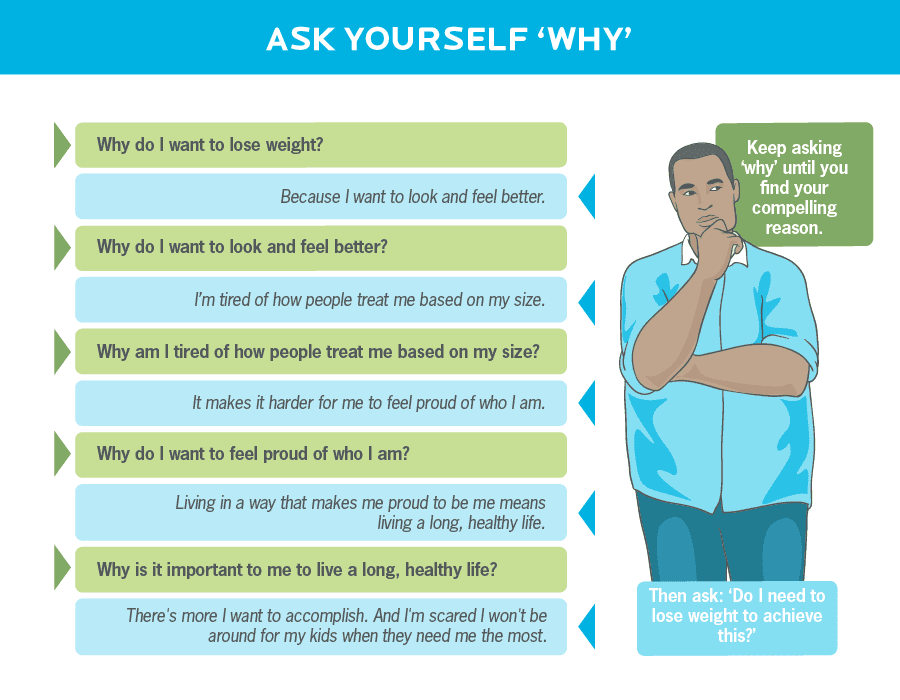
Then, whatever answer your client comes up with, ask why again. And so on, five times, until you get to the heart of what’s really behind their goal.

You can use this worksheet to get started.

This exercise helps clients move past motivations that focus on comparing themselves to others.

Sometimes, when people can’t come up with a compelling deeper reason to lose weight, they realize weight loss might not be what they’re really after. 

(And sometimes it IS weight loss. That’s okay, too.)

#3. Understand that body image exists on a spectrum.

“If you work with clients enough, you know that almost everyone has some kind of body angst. It doesn’t matter what shape they have,” says Dr. Scott-Dixon.

As a coach, you can help people develop more productive, deep-health promoting experiences of themselves in their bodies.

Why should you care? “We know objectively that the more you hate yourself, the worse your life is,” Dr. Scott-Dixon says.

Struggling with body image:

  • Makes it harder to do well academically (especially for women), which can shut down future educational opportunities and chances at landing your dream job 14
  • Increases the likelihood of disordered eating, as well as eating disorders like anorexia nervosa and bulimia, making anything related to food feel like an uphill battle 15 16
  • May make you feel afraid to date or get romantic with someone. (Think: turning off the lights so they can’t see you, or never speaking up about your romantic feelings for someone out of fear of being rejected) 17
  • Can lead to generally feeling like your life sucks (officially, this is called “poor quality of life”), along with having a difficult time going through the motions of daily life, including interacting with other people 18
  • Means you’re less likely to work out or be active, maybe because the idea of going to the gym or moving your body feels super uncomfortable or intimidating 19
  • Increases risk of depression, anxiety, and low self-esteem 20

Many people believe that criticizing themselves will help them excel at changing their habits and living better, healthier lives.

But constant self-criticism and being “down” on yourself can make it much, much harder to adopt healthy habits. 

For example, clients in larger bodies who also struggle with body image sometimes tell us they don’t feel comfortable entering gyms and other fitness or wellness spaces. Often, it’s because they don’t feel these spaces are meant for people who look like them.

While it’s true some gyms aren’t particularly welcoming to people of all body sizes, improving body image can make finding a supportive fitness space and developing regular exercise habits feel much more manageable.

How to respond to body negativity

Chances are, you’ve heard a client say something like:

  • “Ugh, I hate my fat legs!”
  • “I really need to lose this belly fat. It’s disgusting.”
  • “I hate my body right now.”

What can you possibly say to make someone feel better?

According to Precision Nutrition Super Coach Lisanne Thomas, the most impactful thing you can do is ask productive questions.  

You might frame it like this:

“Can I ask you a question about that?”

If they say yes, proceed with something like…

“Imagine your best friend/partner/child just had that thought about themselves. How might you respond to them if they shared that thought with you?”

OR

“Imagine someone speaking to your loved one like that while in your presence. How might you show up for your friend/partner/child in support and response to those words?”

These questions can help people recognize just how unkind they’re being to themselves. 

In a recent Facebook Live, Chrissy King, a writer, speaker, powerlifter, and strength and fitness coach shared her strategy for challenging what our bodies are “supposed” to look like.

When faced with a comment like, “My stomach rolls are so gross,” question what exactly makes them gross, and what standard you’re measuring against.

“This doesn’t come from a place of judgement or shame,” said King. “There are no right or wrong answers. It’s just that we’re taking the time to really think through it. When we really sit with our feelings, underlying a lot of these things aren’t our own personal beliefs. These are things we are taught. These are things that we see societally.”

So it may be worth asking:

  • “What would it mean if you woke up tomorrow and didn’t have that roll on your stomach?”
  • “What would change about your life?”
  • “Would you be a better person?”
  • “Would you be a happier person?”

People may find that their answers surprise them.

Of course, you can’t just snap your fingers and decide to love your body. So think about body image on a spectrum. 

On one end: Body negativity, or actively disliking your body.

On the other end: self-love.

And body neutrality, or “meh,” as we like to refer to it? Somewhere in between.

Here’s the thing: We might exist on multiple parts of the spectrum at once. Human beings are complex, and body dissatisfaction and positive body image aren’t direct opposites of each other. 21
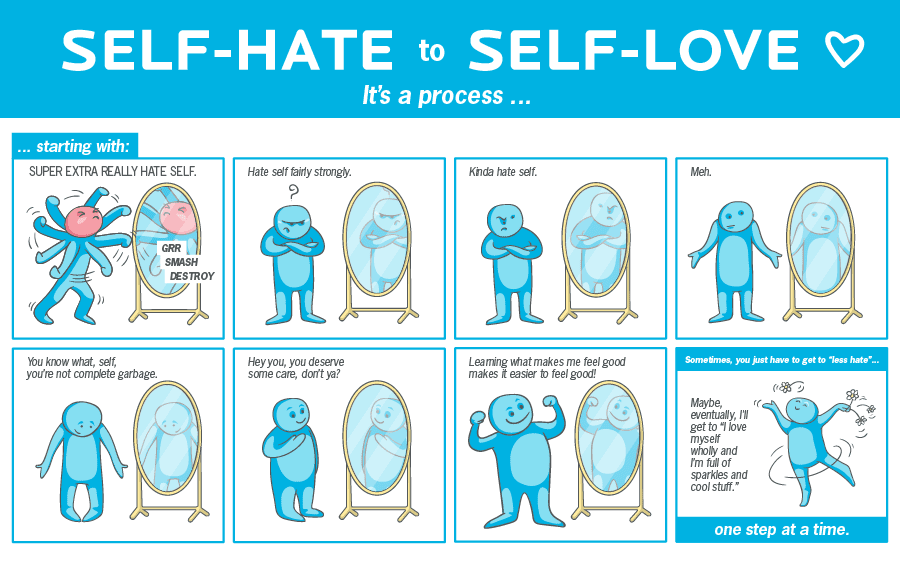
But the goal is to nudge ourselves up the continuum, so we’re spending more time in the body neutrality and self-love sections than before.

The bottom line: You can’t make a client love their body.

But you can refrain from adding more negativity to someone’s baggage. 

And remember, complete body positivity and absolute self-love aren’t necessarily the goal.

“For many people, getting to ‘meh’ is actually a pretty good goal,” says Dr. Scott-Dixon.

Self-love resources

Precision Nutrition Super Coach Lisanne Thomas often talks about self-love with her clients. “My role as a coach is to help a client love and care for their body and do with it what they want,” she says.

While conversations about self-love can be helpful, sharing articles, videos, books, and more that “speak for themselves” may also help start a productive discussion, or just provide food for thought.

Below are some of Coach Lisanne’s favorite resources.

#4. Use language as a signal.

Here’s another coaching scenario to consider:

Your client tells you they ate a pint of ice cream last night. 

What’s your gut reaction?

Think about it. Then read on.

As much as possible, avoid saying anything that might make your client feel ashamed, Solovieva recommends.

Beware of responses that sound supportive, but are actually criticism, like, “Oh, that’s a bummer. How’d you get so off track?” or even, “No worries! We all slip up from time to time.”

“Clients are always listening to see how you talk about things,” Solovieva says. It helps them determine how trustworthy you are with their most difficult feelings and behaviors.

This is important in many areas, but especially when it comes to food. That’s why, when faced with a client eating a late-night pint of ice cream, Solovieva starts with:

“What flavor was it?!”

She might follow it up with any number of questions, like “How are you feeling this morning?” or “Did you enjoy it?”

These kinds of open-ended, judgement-free questions help clients feel comfortable talking about what’s really going on in their heads.

Normalize all food choices.

People aren’t great at remembering or estimating what or how much they’ve eaten. 22 This is often what’s at play when clients say they’re not overeating (or undereating), but still aren’t seeing results.

But there could be another reason clients aren’t reporting their food intake accurately: They don’t feel safe doing so.

And this can be conscious OR unconscious.

Conscious: Your client chooses not tell you about their late-night pint of ice cream because they fear your response—and how it’ll make them feel.

Unconscious: They underestimate their food intake because they want to avoid being shamed for eating eight ounces (or thumbs) of cheese instead of the “acceptable” serving size of one.

In either case, it’s going to make it hard for you as a coach to see what’s really going on.

One way to normalize food choices, according to Solovieva: Openly talk about foods that people may believe are “off limits.” (Friendly reminder: There are no “bad” foods.)

For instance, you might ask:

“What do you normally eat for lunch at work? Is it more like a salad, or a sandwich, or tacos?”

When talking about food planning for the weekend, you might say:

“What are you having for dinner Saturday night? My family always has pizza!”

From there, you can still encourage clients to make their meals “a little bit better” by adding a side of veggies, or upping the protein content. But normalizing your client’s food choices helps you meet them where they’re at.

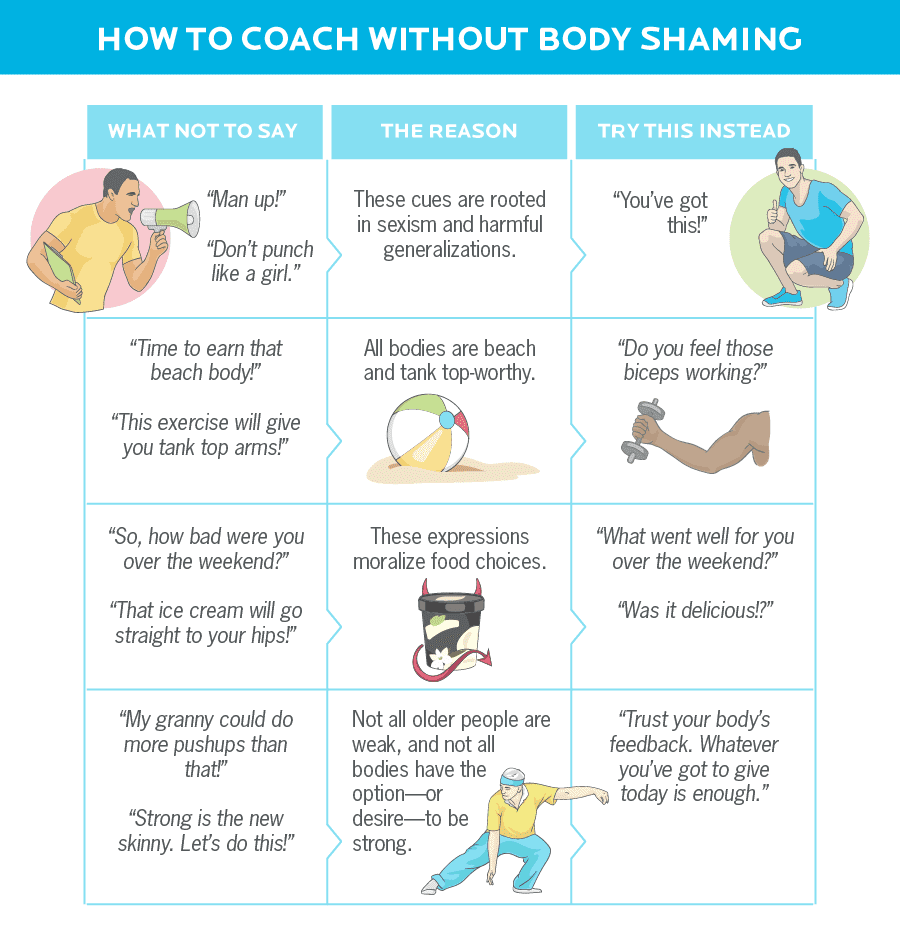
Skip body-shaming “motivational” language.

Many coaches don’t realize certain phrases and cues can make people feel “less than.”

Here are some ways coaches might unintentionally be signaling clients that there’s something wrong with their bodies, plus what to say instead.

(Note: Many of these cues have been commonly used for what feels like forever. So we’re not criticizing coaches for using them. We’re pointing out why evolving your language will ultimately help your clients—and your coaching.)
Model healthy, or at least neutral, body image.

You set an example for your clients. In many cases, they look to you for information about what it means to be healthy and fit.

So saying you’re going to “shred for summer” probably isn’t the best way to signal to your client that their post-baby body (or whatever kind of body) is completely fine.

We’re not saying you need to have it all figured out yourself. 

In fact, it’s common for coaches to:

  • feel shame about or have a complicated relationship with their own bodies
  • feel like an imposter for not fitting into a certain body ideal
  • worry they don’t look “good enough” to attract clients
  • have gone through their own body transformation journey
  • have experienced living in a bigger body themselves (whether currently or in the past)

Ironically, coaches who have been through their own process of coming to health and fitness after feeling ashamed about their bodies are often the best qualified to really understand what clients go through, Dr. Scott-Dixon points out. That’s a superpower in itself.

So if you’re comfortable, it may help to share your own body image journey with clients once you’ve gotten to know them.

Showing vulnerability lets clients know they’re not alone.

Plus, people are more likely to be open and honest about their challenges when they feel you can relate.

No matter where you are on the body negativity to self-love spectrum, be conscious of the language you use. This includes what you say around your clients, in your marketing materials, and in your social media posts.

That way, you can ensure you’re not passing any of your own body image struggles onto others—or reinforcing their existing ones.

#5. Be trustworthy.

Trust is a key element in the coach-client relationship.

Here’s the tricky part: “You can’t make clients trust you,” says Precision Nutrition Coach Jon Mills. “You have to be trustworthy.”

So how do you do that, exactly?

The art of coaching is about being trustworthy for ALL your clients, including those who:

  • are in larger bodies
  • have a disability or chronic illness
  • identify as trans and/or non-binary
  • are part of marginalized communities
  • come from cultures different from your own

You might be thinking: “I don’t have any clients like that!” or “I don’t really cater to any of those groups.”

The truth is that you probably do—even if you don’t realize it.

Many disabilities and health issues, like ADHD and diabetes, can be completely invisible from the outside. You won’t necessarily know someone’s sexual orientation, gender identity, or race from looking at them.

And just because you don’t currently have clients who outwardly appear different from you in terms of body size, race, gender, or in any other aspect doesn’t mean you can’t coach those clients.

What coaches need to know about intersectionality

We can’t talk about weight stigma and bias without talking about race and intersectionality.

Intersectionality is a term coined by law professor Kimberlé Crenshaw. It refers to how social and political categorizations like race, class, and gender interconnect to create both discrimination and privilege. 23

Crenshaw pointed out that when it came to discrimination, the legal system wanted to know, for instance, whether a Black woman was being discriminated against because of her gender OR her race. There wasn’t a framework for understanding how it could be both at the same time. Thus, intersectionality was born.

Intersectionality helps us understand that fatphobia and discrimination against racialized, trans, queer, disabled and other marginalized bodies are all deeply intertwined.

So it’s great to be a size-inclusive coach. But that also means understanding that multiple aspects of discrimination and marginalization compound each other, and how this effect may impact your clients.

Learn more: Racism and fatphobia

Learn more: Developing an intersectional coaching practice

It’s not as hard as you think.

Maybe you’re wondering: How can you possibly become an expert in body positive coaching, coaching trans athletes, working with people with disabilities, and anti-racism?!

This may come as a relief: You don’t have to be an expert. 

First, you can turn to plenty of experts for help. Many of these activists have courses, books, and other resources, like the ones listed in the boxes throughout this article.

But what’s even more important, Mills says, is this:

Clients are experts in their own experiences. 

Usually, you can learn directly from them.

That doesn’t mean it’s their job to educate you.

But you can listen to and engage with the lived experience of the person right in front of you, Mills suggests.

“Often, it’s not even that they need you to be really involved in their personal experience as their coach. They just need to know that you’re not going to devalue it.”

We have work to do.

Many of us have hidden biases, body image concerns, and areas where our awareness is lacking.

To grow into more inclusive coaches, according to Mills, we first must lose the “fix it” mindset. We won’t solve weight stigma, racism, or any other type of discrimination by changing the equipment in a gym or taking a course. (Though those can be good action steps.)

“When we try to fix problems, we’re trying to get a sense of control,” Mills points out. “And to meet people where they’re at, you need to lose that desire to control things and be open and receptive.”

And meeting clients where they’re at? That’s what matters most.

References

Click here to view the information sources referenced in this article.

If you’re a coach, or you want to be…

Learning how to coach clients, patients, friends, or family members through healthy eating and lifestyle changes—in a way that’s personalized for their unique body, preferences, and circumstances—is both an art and a science.

If you’d like to learn more about both, consider the Precision Nutrition Level 1 Certification. The next group kicks off shortly.

The post Are you body-shaming clients? How even well-intentioned coaches can be guilty of “size-bias.” appeared first on Precision Nutrition.


from Blog – Precision Nutrition https://www.precisionnutrition.com/size-inclusive-nutrition-coaching
via Holistic Clients

Tuesday, 20 October 2020

5 ways to beat imposter syndrome: Health and fitness pros tell you how they did it.

“Does anyone else here struggle with imposter syndrome?”

Jamie posed her question to the Precision Nutrition Coaches Facebook Group, wondering if other coaches ever felt the same way.

“I know I am certified and have the information and skills that I need to coach,” she wrote. “But I have that persistent voice in my head that tells me I’m not qualified enough.”

In minutes, Jamie’s post was flooded with responses.

The dozens of answers she received amounted to a collective “Yes!”

Jamie definitely isn’t alone. And if you feel the same way, neither are you.

The good news?

For every coach who struggles with imposter syndrome, self-doubt, and insecurity, there’s also one who’s overcome it (or at least learned to effectively manage it.)

In this article, we’ll pull back the curtain on imposter syndrome, sharing the stories—and strategies—of coaches who’ve been through it. And we’ll offer helpful advice from our own experts.

Then you’ll be on the road to conquering your self-doubt, leveraging your own expertise, and coaching with confidence.

(Side note: Yes, we know most dictionaries spell it “impostor.” But because it seems more people use “imposter”—a spelling that’s also considered acceptable—we chose that version.)

++++

In the Precision Nutrition Level 2 Certification, there’s a lesson we call “The Secret.”

In this lesson, we ask our students:

Do you have a secret angst or worry about coaching?

When you think about that secret, what is it like? How does it make you feel?

Coaches aren’t required to share their secrets with us, but lots do.

And, considering the Level 2 Certification is an advanced Master Class, their answers might surprise you.

According to Precision Nutrition Level 2 Master Coach Jason Bonn, “By far the most common response is about imposter syndrome, stemming from not ‘knowing enough’ or not being ‘good enough.’

“Almost everyone falls somewhere on the spectrum of not feeling ‘enough’ in some way,” says Bonn. “Though some feel it much more deeply than others.”

(The second most-common secret? Concerns about one’s own body or physique. Read: Am I fit enough to be a trainer?)

What is imposter syndrome?

Imposter syndrome is the nagging feeling that you’re somehow not good enough to do what you’re doing and that eventually, someone will find out.

This often-unfounded yet persistent feeling can interfere with your confidence, mess with your coaching skills, and steal the joy and passion that led you to do this work in the first place. It might even stop you from coaching altogether.

How do you overcome imposter syndrome?

To find out, we spoke with six PN Certified coaches who’ve been through it themselves, and sought advice from our own top coaching experts.

Here are five proven strategies to try.

Strategy #1: Be a coach, not an expert.

Previously a successful chef, Robbie Elliott made a career transition and became a coach in his mid-30s. But the change came with a ton of anxiety.

He feared client questions and positively dreaded having to say the words, “I don’t know.”

“When you don’t know the answer to a question, and you’re supposedly the voice of the professional, it can be really deflating,” says Elliott.

“There were times early on in my career that I would get things wrong simply because I wasn’t sure, but I really wanted to give an answer.”

In time, Elliott learned that “trying to be the person who knows everything is actually really detrimental. Being authentic and honest, and then dedicating yourself to finding the answer is way, way better.”

Elliott’s new mantra? “I might not be the perfect coach, but I can be the dedicated coach.”

Srividya Gowri had a similar revelation. Once hyper-concerned about being perceived as “The Expert,” Gowri eventually realized that “I don’t need to be the expert. I don’t need to know everything. If my clients are getting the results they want, that’s what matters.”

This mental shift relieved Gowri’s imposter syndrome—and changed her coaching style.

“I’m not setting huge expectations and saying ‘I’m this perfect coach and I’m going to get you these results,’” she explains. “No, I’m saying ‘We’re going to try things together, and experiment, and see what works for you’. This eases the pressure for both me and my clients.”

Put it into action

In the Precision Nutrition Level 2 Certification program, coaches are taught that while you may be the expert on nutrition, the client is the expert on their experience.

Here are a few ways you can put this into practice.

1. Assume nothing. 

Ask about and confirm every single proposition and assumption you make with a client. Be clear that you’re using a working hypothesis rather than an “expert pronouncement.”

For example, you might say,

“OK, here’s my take on things. Did I get that right?

“Based on my experience, here’s what I’m guessing will work for you, but we may need to test it and see how it turns out.”

“It sounds from what you’re saying like _____ might be a good next action?”

2. Be honest if you don’t know something. 

Saying “I don’t know but let’s find out together” is powerful stuff.

If your client’s experience is different than yours, level with them.

For example, you might say: “I’m going to be truthful with you. I don’t know much about cancer survivors. But I’ve got a good toolbox of things, and I’m prepared to collaborate with you and do what it takes to become informed. I’m on your team all the way. We’ll work through this together.”

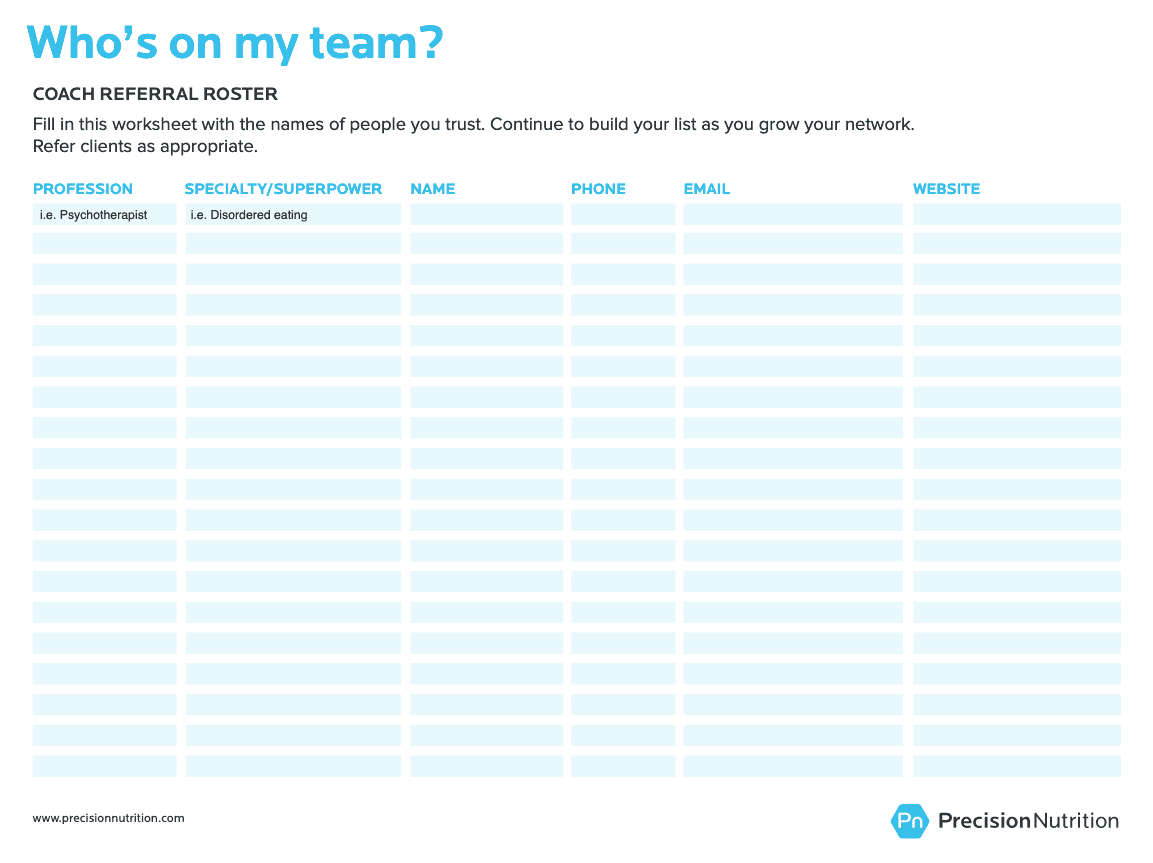
3. Build a referral network. 

You don’t need to be (nor should you be) the expert on absolutely everything.

Building up a referral support network can give you an opportunity to help your clients even when their needs are outside your scope—by referring them to someone who can legitimately help. (Start building your referral roster by clicking the image below to get the downloadable form.)

Strategy #2: Gather feedback, intelligently.

Feedback—both positive and negative—can be an effective antidote to imposter syndrome.

For example, Kay Sylvain had been really hesitant to put her qualifications into action and start coaching clients. But once she did, she found that their positive feedback helped a lot.

“Getting positive feedback reminded me that sometimes the way we view ourselves is not necessarily how others view us,” she says.

But even negative feedback can be helpful too. 

“Maybe you do need more time, experience, knowledge, or skills to be the kind of coach you want to be,” says Dr. Krista Scott-Dixon, director of curriculum at Precision Nutrition.

“Imposter-syndrome-type anxieties can reflect a completely valid urge towards self-improvement. The problem with anxiety is that it lives in your head, thriving on isolation and shame.”

Getting clear on how and where you have room for improvement can ease the anxiety.

Take Greg Smith. In his early days as a coach, Smith was terribly worried about coaching “right,” trying to avoid mistakes at all costs.

Now, instead of worrying about doing the wrong thing, or not doing enough, he gathers feedback (or “data”) he can use for small, incremental improvement.

“When my clients are trying something new, I tell them the worst thing that happens is you learn what didn’t work for you. And then you get data to help you do it better or differently next time. The same is true for ourselves,” he says.

According to Robbie Elliot, this “data gathering” approach might be best paired with an added step: data filtering.  

“I try to be obsessively open to feedback. But if you take every little bit of feedback to heart—including from random people on the internet who don’t know you—you’ll be questioning yourself all the time.

Instead, Elliott concentrates on deliberately sourcing feedback from people he trusts. That includes his family, a close group of friends and colleagues, and his PN coaching mentor, Jason Bonn.

Elliott takes critical feedback from that group very seriously. “I know their values, and they know mine,” he says. “I trust they will tell me if I need to look at something or do something better. Their feedback keeps me accountable.”

Put it into action

It’s hard to actively solicit feedback, and use it constructively—if you’re deathly afraid of screwing up.

To help you become more receptive to feedback, try an approach that we at PN call “feedback, not failure.”

First, imagine this. You’re walking on a rocky surface—maybe a beach, or a dry creek bed, or a hiking trail.

If you step on a rock, and it shifts, did you fail?

No.

You just got important information about the next thing to do—try another rock.

You got feedback.

Instead of treating any mistakes or slip-ups as failures, try to see them as feedback, and approach them with curiosity.

For example:

  • Look at the choices you make, and notice what happens.
  • What information did you get? What insight? What data?
  • What does that feedback tell you about what you could do next, or change in the future?
  • Or keep the same? Or do less/more of?
  • What happens when you take action X? What happens when you do Y? What about Z?

Get rid of the words “good” or “bad” and substitute “interesting” or “useful,” as in: “Well, that’s interesting,” or “That’s useful to know.”

With this mindset, you can start to treat all feedback as neutral information that you can use to make decisions—with less fear of failure.

Strategy #3: Question your thoughts and assumptions.

Have you ever felt like other coaches, practitioners and professionals have more or better qualifications than you?

That’s exactly how Heather Lynn Darby used to feel. Earlier in her coaching journey, she compared herself to “other professions that are licensed.”

In particular, she worried that nutrition coaching would be seen as “less legitimate” than a registered dietician (RD), doctor, or psychologist. Maybe clients wouldn’t respect her credentials or see the true value she had to offer.

Rather than letting her assumptions take over, Heather Lynn practiced some critical thinking.

“I asked myself, ‘Why would someone come see me instead of a registered dietician? What’s the unique value I bring that’s different from an RD?‘”

She came up with loads of answers: like being able to offer more personal and frequent contact to clients, something clinicians like RDs aren’t always able to provide their clients.

“That differentiation helped me discern my unique value and concentrate on that,” she explains.

In addition, Heather Lynn challenged her fears by asking: “Is this true?”

“The process goes like this: If you’re assuming something negative about yourself or your situation, ask yourself the question: ‘Is that true? Are your achievements fake? Did you or did you not complete those certifications? Was it really just luck that got you where you are now?’”

You might discover the answers by reflecting on your past. 

That’s what Srividya Gowri did.

In her early years as a coach, Gowri felt “like a fish out of water. I worried, do I know everything? Do I have the talent and skills to actually help someone who’s so different from me? What if it doesn’t work? Are people going to call me out and say, ‘Hey, you’re fake. Your coaching didn’t work on me?’”

To challenge her fears, Gowri took a step back. She reflected on all the changes she’d made in her life, the challenges she’d worked through, and the successes she’d had.

This led to a profound lightbulb moment.

“When I looked back I realized: You know what, maybe nutrition coaching is new for me, but learning something new is not new. I have learned. I have succeeded. I have been able to do very well. And there’s a lot I’ve overcome with grit and resilience.”

Put it into action

When uncomfortable thoughts or feelings crop up, try writing them down, says Karin Nordin, PhD(c), behavior change coach and curriculum advisor to Precision Nutrition.

“You might find it helpful to explicitly write down: What is it that you think makes you an imposter?”

Once your thoughts and assumptions are on the blank page in front of you, consider them critically.

“Ask yourself, ‘Do I actually believe that’? From there you can start that metacognitive process to consider and challenge your own thoughts.”

As an added step, try taking a page out of Gowri’s book. Make a list of your previous accomplishments and a list of challenges you’ve overcome. How did you make it through those difficult times? What strengths, skills or assets have those experiences given you?

By looking back and re-familiarizing yourself with your own history, you might realize you’re more prepared and capable than you thought.

Strategy #4: Seek improvement and mastery rather than trying to avoid failures.

Do you tend to focus on avoiding mistakes? Or on making improvements?

According to Nordin, if you have imposter syndrome, your focus is likely on avoiding mistakes—as opposed to being awesome.

“Research suggests that people with imposter syndrome tend to focus on performance-avoidance—trying to avoid mistakes—rather than improvement or mastery,” says Nordin.

This can translate to thoughts like, ‘I’m a fraud, I don’t know what I’m doing, I’m afraid of messing up in front of everyone,’ rather than thoughts like, ‘How can I get better at this?’

The solution?

Try to shift towards mastery goals (goals focused on improvement), rather than performance-avoidance goals (goals focused on preventing mistakes).

For Chaquita Niamke, this was a significant mental shift.

Earlier in her career, if Niamke made a mistake with a client, she felt so embarrassed, she didn’t want to show her face. (She even found herself ducking a previous client in the grocery store.)

But in time, she became more focused on working towards her bigger goals and the things she needed to do to get there.

“I know when I have a plan and a process, the imposter syndrome is not as prevalent,” she says.

Niamke also learned to “embrace the road to mastery, with all its lumps and bumps along the way.”

“I came to realize the process is the process,” she adds. “You have to go through it in order to be refined.”

Put it into action

To get out of your imposter syndrome mindset, try shifting your focus towards improving the things you want to master, rather than focusing on avoiding the things you’re afraid of.

To do this, Nordin suggests a “thought bridge.”

“Suppose you think you’re not the best coach right now,” she says. “Rather than saying, ‘I’m not a great coach,’ try telling yourself, ‘I’m not the best coach, but I can get better.’”

From there, Nordin recommends focusing on the things you’d like to improve.

For example, you might say to yourself: “I really want to master motivational interviewing. So in this client session, I’m going to focus on my motivational interviewing skills.”

Or you might say, “I really want to be a compassionate coach. So in this session, I’m going to practice being as compassionate as I can.”

These stepping stones can build a path to confidence, while helping your brain think more productively and creatively.

“After a while, you might say, ‘Hey, I’m a pretty great coach after all, because I’ve worked really hard at it. And I know I can always get better.”

Strategy #5: Put in the reps.

There’s no getting around it.

Gaining confidence, developing your skills, and feeling solid in who you are and what you offer… these kinds of things take time, effort, and experience.

“If you don’t get your reps in, the imposter syndrome just stays there,” says Niamke. “You have to go through it.”

Greg Smith agrees. As a young coach, he constantly worried whether he was “doing  it right.” But looking back, he now says, “I practiced coaching just like the clients have to practice their eating habits. It doesn’t happen overnight. You need to put in the reps.”

But sometimes, it can be really hard to get started.

After receiving her PN Level 1 Certification, Kay Sylvain was still hesitant. “I was like, ‘Okay, I passed the test, but I’m not really ready to coach.’”

Her imposter syndrome kept telling her to wait. So she got more certifications and more training.

“And I still wasn’t doing anything with it. Just hoarding knowledge, reading books. I came to a point where I said to myself, ‘Am I really going to start this or am I just going to keep taking courses?’”

Sylvain finally realized that she wouldn’t magically feel confident enough. So she chose to get started anyway.

“I said to myself: Either you’re going to do this, or you’re not,” says Sylvain. “After that, I filed all the paperwork, set things up, and finally started my business in the span of a week.”

Put it into action

“Put in the reps” might seem like obvious advice. But sometimes we forget about it (or don’t take it) because we set unrealistic expectations for ourselves.

For a re-set, try this thought experiment from Dr. Scott-Dixon.

Suppose a client comes to you. They’re about 25 pounds overweight, especially in their midsection.

They tell you they want visible abs.

And they want them in one week.

You try to reason with them. Explain the physiology. Show them examples of other clients so they can set their expectations accordingly.

In turn, your client says, “That’s all well and good for other people. But I’m different. I should be able to get abs in a week.”

What would you think?

You’d probably be shaking your head (at least on the inside).

“If you’re just starting out and expecting to be successful, confident, even perfect overnight, you’re basically asking for ‘abs in a week,’” says Dr. Scott-Dixon. “In other words, you’re not thinking realistically about what it really takes to meet a goal.”

Instead of worrying about whether you’re good enough (or not), get clear about your goals, and set a realistic plan to achieve them.

To get started, try the PN “Goals to Skills to Practices to Actions” method. (We call this GSPA.)

First, take out a piece of paper and write down your goal. Make it as specific and concrete as possible.

Then, reverse-engineer what’s required to achieve that goal. Ask yourself:

  • What skills do I need to develop to meet my goal?
  • What practices will help me develop these skills?
  • What actions do I need to take, and when?

Clarifying what you want to improve will allow you to make progress, and see concrete, measurable improvement as you go.

Bit by bit, progress by progress, rep by rep, you’ll probably stop feeling like an imposter. And you’ll start to see yourself becoming the coach you always wanted to be.

If you’re a coach, or you want to be…

Learning how to coach clients, patients, friends, or family members through healthy eating and lifestyle changes—in a way that’s personalized for their unique body, preferences, and circumstances—is both an art and a science.

If you’d like to learn more about both, consider the Precision Nutrition Level 1 Certification. The next group kicks off shortly.

The post 5 ways to beat imposter syndrome: Health and fitness pros tell you how they did it. appeared first on Precision Nutrition.


from Blog – Precision Nutrition https://www.precisionnutrition.com/imposter-syndrome
via Holistic Clients

Friday, 16 October 2020

Level 1: 9 ways to take the anxiety out of nutrition for kids. [Infographic]

If you’ve ever (briefly!) thought about duct-taping your kid to a chair while you wedge a forkful of spinach into their mouth, you know the frustration and anxiety many parents experience around kids’ nutrition.

“Are they eating enough?”

“Are they getting the right nutrients?”

“Why won’t they eat anything green??”

“Am I failing as a parent???”

“WHO’S IN CHARGE HERE ANYWAY?!”

We feel you.

The good news: It is possible to help kids get the nutrients they need without everything being perfect. Because let’s face it: When does that ever happen?

We’ve worked with over 100,000 clients—many of whom are parents and guardians looking to bring more peace to mealtime and more greens to their fridge.

Here’s what we tell them: You don’t need to win the Best School Lunch contest, make the world’s healthiest family dinners, or demand your kids eat a heaping plateful of vegetables.

Instead, we recommend another approach: Be gently persistent, and take the long view.

When kids have some choice and control, a basic understanding of why nutrition matters, and a safe, low-stress environment to try some food experiments… a lot can change. (For the better.)

Check out the infographic below for nine ways to help your little ones make healthier food choices on their own.

Plus, five recipes that draw on family-favorite foods that most kids will love. No duct tape required.

Download the tablet or printer-friendly infographic to share it with friends, family, or (if you’re a coach) clients.

Nutrition for kids can feel like advanced algebra thanks to picky eaters and hectic schedules. Try these low-stress strategies, plus 5 kid-friendly recipes.

Don’t forget to download and save this infographic so you have low-stress strategies for kids’ nutrition when life gets busy.

If you’re a coach, or you want to be…

Learning how to coach clients, patients, friends, or family members through healthy eating and lifestyle changes—in a way that’s personalized for their unique body, preferences, and circumstances—is both an art and a science.

If you’d like to learn more about both, consider the Precision Nutrition Level 1 Certification. The next group kicks off shortly.

The post Level 1: 9 ways to take the anxiety out of nutrition for kids. [Infographic] appeared first on Precision Nutrition.


from Blog – Precision Nutrition https://www.precisionnutrition.com/nutrition-for-kids-infographic
via Holistic Clients

Thursday, 15 October 2020

Is a nutrition certification worth it? 5 questions to ask yourself before signing up.

What do a doctor, dietitian, licensed clinical social worker, side-hustling nutrition coach, and personal trainer all have in common?

No, this isn’t the beginning of a terrible joke…

The answer: We interviewed people in each of these careers, and they all said getting a nutrition certification was worth it. 

But is a nutrition certification worth it, for you?

In this article, we’ll explore that question.

The truth is, a nutrition certification’s worth-it score depends on your situation.

To help you weigh all the pros and cons, we put together this comprehensive guide, complete with a free self-assessment tool to help you make the decision for yourself.

In this article, you’ll also find:

  • The essential questions to consider before getting a nutrition certification.
  • 5 unexpected side benefits of getting certified.
  • Why a nutrition certification often translates into greater client success.
  • How a nutrition certification can boost your income potential.
  • Insights from seven successful certified nutrition coaches from a wide range of professions.

++++

5 questions that’ll help you decide if a nutrition certification is worth it

Figuring out whether a nutrition certification is worth it can be tricky. In part, because we all define “worth it” differently.

For instance, is a nutrition certification worth it if you:

  • Gain knowledge you need to achieve your career goals?
  • Earn more money because of it?
  • Get more clients or new opportunities afterwards?
  • Learn something that changes your nutrition philosophy?
  • Create connections with like-minded people in your industry?

Consider the following questions to define what “worth it” means to you.

How to use this quiz to make your decision

Each section below ends with a question. You’ll rank your response on a scale from 0 to 5. (Just click the number on your screen, and your results will automatically populate at the end of the quiz.)

Once you’ve answered all five questions, you’ll get a worth it/not worth it result.

If you’re not sure how to answer one or more of the 5 questions (or just want to consider it from multiple angles), you’ll find boxes labeled “dig deeper” with prompts for further reflection.

Our advice: Keep a journal handy. Jot down your thoughts so you’ll have something to refer to when making your decision.

Question #1: Does a nutrition certification fill a gap in your knowledge?

A nutrition certification is worth it if it helps you gain key knowledge or skills, according to the coaches we interviewed.

Here are a few real-life examples of how a nutrition certification can fill knowledge gaps.

The personal trainer who wanted to master nutrition

The release of a massively popular Netflix nutrition documentary, coupled with a resulting deluge of client questions, made personal trainer Tyler Buckingham, PN1, PPSC, realize the full extent of nutrition misinformation.

He wanted to better understand the discussion as well as be able to answer client questions with authority. “I was like, okay, it’s time to get certified in nutrition,” says Buckingham, who trains a group of former athletes.

Since getting certified, he’s much more adept at answering the nutrition questions clients lob his way—especially tricky ones with no clear answer.

“I like having that flexibility and being able to say, ‘Hey, you could try this, or you could try that. What do you want to do? Let’s have a conversation about it.’”

In the end, Buckingham knows his clients are getting answers to their questions, and the actionable advice they need to keep moving forward.

The doctor who wanted to give better advice

A family medicine resident and CrossFit Level 1 coach, Kristina Hines, DO, PN1, felt confident talking to patients about exercise. But the few hours of nutrition education she got in medical school just weren’t cutting it.

“I didn’t really know what to tell patients nutritionally,” she says.

Her patients often had specific questions about how to eat, whether various diets were right for them, and what foods calmed their symptoms.

Dr. Hines wanted a deeper level of nutritional understanding, so she decided to pursue a nutrition certification.

Thanks to the certification course, Dr. Hines now feels comfortable answering just about any nutrition question patients come up with.

The registered dietitian who wanted to learn about behavior change

Jennifer Broxterman, MS, RD, was already a dietitian when she got her nutrition certification. But she wanted to learn more about the psychology of behavior change and motivational interviewing.

“As a university professor, I like to see different teaching methods and different learning styles,” she says.

For her, getting a Precision Nutrition Level 1 certification meant gaining perspective on how behavior change actually works, so she could better implement it with her clients.

Will a nutrition certification fill a gap in your knowledge?

already know everything have a major knowledge gap
012345

Dig deeper

  • What are you hoping to learn from a nutrition certification? How will the certification help you learn it?
  • What skills would help you reach more people, or improve your work with them? Could a nutrition certification help?
  • How do you feel when nutrition questions come up? How does that compare to how you’d like to feel?

Question #2: Will a nutrition certification bring you additional and valuable benefits?

People often cite benefits of becoming certified that go beyond their initial reason for doing so, such as:

  • enhanced credibility
  • more confidence
  • improved communication skills
  • opportunities to learn from peers and experts in the field
  • a healthier relationship with food

Below, we’ll cover each of these benefits in detail, so you can decide if they’re worth it for you.

Benefit #1: Enhanced credibility

After Vivian Gill, MA, RN-BC, CPT,  earned her nutrition certification, she noticed something that surprised her: “My credibility increased,” says the registered nurse, personal trainer, and lifestyle coach. “Clients know I’m evidence-based and not biased, and they’ve felt the difference.”

Gill saw that lots of other trainers in her community pushed dieting, counting macros, and detoxing. Her nutrition certification helped her realize that a different approach would resonate more with her clients.

“I’ve decided to be the voice of reason and grace,” she adds.

Benefit #2: More confidence

What does Buckingham see as the biggest hidden benefit of getting certified? “Definitely the confidence I have now,” he says.

Not long ago, a client came to him wanting to lose weight. During their intake, Buckingham learned the client had already lost several pounds. Clearly, the person was doing a lot right.

In the past, Buckingham would have felt pressured to deliver a completely different program—for the sake of it. Thanks to what he learned from his certification, however, he confidently encouraged his client to keep going with some of the same strategies.

Buckingham also feels more at ease talking about nutrition’s gray areas.

Instead of claiming to know it all, he feels comfortable saying: “Hey, I don’t know the answer to this question, but I’ll find out,”  or “Why don’t we see if it works? Then after a week, we can see what happened, and take it from there.”

Benefit #3: Improved coaching and communication skills

Some nutrition certification courses, like Precision Nutrition Level 1, include information on the art of coaching as well as nutrition science. In other words, part of the course trains you to talk to your clients more effectively. (Want to see what we mean? Check out our FREE Nutrition Coaching e-course.)

Josh Chang, PN1, a dietitian and owner of Mycro Nutrition, says getting a certification was worth it for him because it taught him how to talk to clients about their barriers.

“Dietitians are trained to use a little bit of motivational interviewing and empathize with clients, but Precision Nutrition teaches you to take that one or two steps further—to get to know the client and how to dig into why they might be saying what they say or doing what they’re doing.”

“A nutrition certification may be worth it if you need a little help strengthening those communication or rapport building skills,” he adds.

Benefit #4: Opportunities to learn from peers and experts in the field

Some nutrition certifications offer Facebook groups, online forums, and even in-person events. These resources provide coaches with a chance to connect with like-minded health professionals, get input from others on challenges and, in some cases, access top experts in the nutrition field.

Having a large community of coaches at his fingertips was one of the biggest unexpected benefits for Chang.

“Once you enroll in PN Level 1 or 2, you get invited to a Facebook group. I particularly enjoy seeing how different coaches respond when people post questions. Some coaching suggestions are just so out of left field, in a good way. I’m like, ‘I would’ve never thought of that, but it’s brilliant.’”

Benefit #5: A healthier relationship with food

Jenna Ashby PA-C, PN1, an oncology physician assistant, decided to become a nutrition coach after overcoming disordered eating.

Though Ashby primarily uses her nutrition certification in her side job at Breathe CrossFit in Derry, New Hampshire, she also came away from the experience with some personal takeaways.

“It helped solidify what I’ve been building upon the last few years, and it helped me find more peace with myself,” says Ashby. “I now know, without a doubt: I can love my body, be okay with my body, and appropriately nourish it.”

“That’s huge because I once thought that, if I wanted to eat, I had to exercise, or vice versa. Now, that mentality is reversed: In order to be strong and feel strong I need to nourish myself. The PN certification really solidified that for me,” she says.

Will a nutrition certification bring you additional and valuable benefits?

not valuable at all massively valuable
012345

Dig deeper

  • How would you like clients to view your knowledge about nutrition, and how do you think you’re currently measuring up to that?
  • How confident do you feel about your nutrition recommendations when working with clients? When you aren’t sure about something, how do you handle it?
  • How would you rate your current coaching and communication skills? When you talk to people about nutrition, how does your message seem to be received?
  • Where do you currently connect with peers and experts in your field? How might you benefit from additional opportunities?
  • How would you describe your current nutrition philosophy and your relationship with food? Is there room for improvement here?

Question #3: Does a nutrition certification line up with your career goals?

A nutrition certification enables you to make nutrition recommendations to otherwise healthy clients. 

With a nutrition certification, you’ll be qualified to:

  • Give the right nutrition advice at the right time
  • Develop an action plan your clients will actually follow
  • Help people transform their bodies and their health

These qualifications can be useful in a variety of careers.

What are your career opportunities with a nutrition certification?

People often wonder if they need to go to (or go back to) a university to get started with a career in nutrition. For certain jobs (such as registered dietitian), you need a specialized degree and training.

But there’s also a lot you can do with a nutrition certification alone. Coaches in our community have job titles like:

  • Nutrition coach
  • Sports nutrition coach
  • Weight loss coach
  • Weight management consultant
  • Corporate wellness educator
  • Nutrition program manager at a gym or other health facility
  • High-performance consultant
  • Stay-at-home parent and part-time nutrition coach

If you already have additional certifications or degrees (or plan to get them), there may be other career options. Some PN-certified coaches are also:

  • Registered dietitians
  • Sports nutritionists
  • Personal trainers and strength coaches who do nutrition coaching
  • Physical therapists who do nutrition coaching
  • Doctors, nurses, and physician assistants who do nutrition coaching
  • Psychologists, psychotherapists, and social workers who do nutrition coaching

What are you not qualified to do?

It’s important to note that Medical Nutrition Therapy (MNT)—which involves giving nutrition advice to treat or cure disease—is out of scope unless you’re specifically MNT-accredited. You won’t be qualified to do this with a nutrition certification alone, and you should never try.

Depending on where you live, rules and regulations vary on what people with nutrition certifications are allowed to do.

For instance, in some states in the US, the only people who can provide meal plans are registered dietitians. But in these states, nutrition coaches can still help people with their eating as long as they’re not telling people exactly what they should and shouldn’t eat.

If you take a Precision Nutrition certification, you’ll learn that meal plans, deeming foods “off-limits,” and telling people exactly what to eat aren’t our style anyway. In our nutrition certification, you’ll learn how to get results without using these tactics.

Does a nutrition certification line up with your career goals?

don’t line up at all yes, they completely line up
012345

Dig deeper

  • How can nutrition coaching fit into your current job? Or are you looking to pursue a new career in nutrition?
  • Take a look at the job titles listed above. Which ones sound interesting to you and/or resonate with your career goals?
  • Do you need a nutrition certification to be qualified (or feel confident enough) to hold the job titles you listed in the previous question? Why or why not?

Question #4: Will a nutrition certification help the clients you work with (or want to work with)?

Our grads say a nutrition certification can help you provide a better service to your clients (or potential clients). This service can not only focus on what they eat, but also how they think, feel, and go about their daily routine. (We call this “deep health” coaching.)

This allows you to figure out what’s really holding clients back from making the lasting changes they really want.

That’s important since many people get a nutrition certification, at least partly, because they want to help people—even if it’s their friends or family members. So it’s worthwhile to consider how getting certified will help the people you work with (or eventually want to work with).

For instance, Buckingham now includes nutrition coaching his personal training clients as an added value service. “If you’re meeting me in person, I’ll often say, ‘Hey, let’s talk nutrition. Let’s make sure that you get those questions answered,’” he explains.

Getting a nutrition certification may also improve client experiences. “I think it’s made me a better practitioner,” Dr. Hines says.

Developing her motivational interviewing skills, she says, helped her approach conversations about nutrition in a way that makes patients feel more at ease.

“Now, I’m able to meet my patients where they are instead of having them feel like I’m just lecturing them. I really try to empower patients to know that they have a say in this. It’s not just me telling them what they have to do.”

Lastly, a nutrition certification may help clients get better results.

For example, Kelly Lynch, LCSW, EMT, CPT, PN1, a therapist who specializes in treating first responders, began suggesting clients talk to their physicians about blood work and other diagnostic tests, especially when she suspected their mental health symptoms might be related to (or exacerbated by) nutritional deficiencies, GI dysfunction, or hormonal issues.

When one of her clients described worsening depression along with digestive issues, Lynch thought of a condition she’d learned about during her certification that could contribute to these symptoms: SIBO (small intestinal bacterial overgrowth). She encouraged the client to ask their doctor about it.

Sure enough, testing revealed Lynch’s hunch was correct, and the client’s depression improved once the SIBO was treated.

Will a nutrition certification help your clients?

won’t help at all will help majorly
012345

Dig deeper

  • What additional value would your clients receive if you got a nutrition certification?
  • How would more knowledge and better coaching/communication skills improve clients’ experiences?
  • In what way would nutrition and coaching expertise help your clients get better results?

Question #5: Will a nutrition certification boost your income potential, or provide other financial benefits?

Based on our survey of 1000 nutrition coaches and additional independent research, coaches with a nutrition certification earn slightly more per hour than coaches without one.

If you have two to three certifications, you’ll earn an average $12 more per hour than coaches with just one.

And coaches with a Precision Nutrition certification earn 11 percent more than people with other certifications.

So it’s safe to say that, on average, certified coaches earn more.

For Chang, getting a nutrition certification was the impetus to start his own coaching business, getting him out of a hospital nutrition setting and into the driver’s seat of his own career and earning potential.

Lynch experienced greater interest in her therapy services after sharing that she’d gotten certified in nutrition. It also helped her launch a coaching side business, providing an additional revenue stream.

For some, a nutrition certification might be an avenue to saving money. In addition to enabling her to start a side job as a nutrition coach, Ashby says getting certified meant she no longer felt like she needed to pay for nutrition coaching from someone else. Now, she feels totally confident adjusting her own eating habits.

Will a nutrition certification boost your income potential, or provide other financial benefits?

not at all yes, absolutely
012345

Dig deeper

  • Will getting a nutrition certification allow you to charge clients more than you are currently, or offer new services?
  • How might getting certified in nutrition increase interest in your services? Could it help expand your client base?
  • How might getting a nutrition certification potentially save you money, in terms of services you’ll no longer need or outsourcing you’ll no longer have to do?

So is a nutrition certification worth it?

YOUR TOTAL SCORE: –

Now find your score range to see if a nutrition certification is worth it.

20 and above: Yes, a nutrition certification is worth it for you!

Based on your answers, it sounds like a nutrition certification will pay off. By getting certified, you’ll level up your:

  • nutrition science and coaching knowledge
  • career opportunities and coaching services
  • ability to help clients
  • income potential
  • and so much more.

6 to 19: A nutrition certification might be worth it for you.

Based on your answers, it sounds like a nutrition certification will pay off in some ways, but might not in others.

The big question for you to consider: Do the likely benefits outweigh the costs?

To answer that, take another look at your quiz answers, specifically at the ones where you scored a 4 or 5.

Compare the benefits with the cost associated with getting certified.

For example, let’s say you ranked high for a certification filling a knowledge gap as well as for it likely bringing in more income. For costs, maybe you already have the money set aside as well as the time to take and pass a course. In that case, you’ll likely decide that a certification is worth it.

On the other hand, let’s say you picked 5 for a certification lining up with your career goals. For all of the other questions, you choose a 3 or lower. On top of that, you’d have to borrow money to pay for a certification. And you’re already working two jobs. Oh, and you’ve got a baby on the way. Well, a certification might not be worth it to you—not right now anyway.

5 and under: It doesn’t seem like a nutrition certification is worth it for you.

Based on your answers, it’s not clear that you’ll find a nutrition certification to be worth it. That said, there are always exceptions.

You might be interested in getting a certification just for your own personal benefit—not for your career. You may not want to work with clients, earn money through nutrition coaching, or change jobs, and that’s totally legit.

No matter what you decide, it’s important to have a clear picture of your reasoning. Hopefully, that’s what you’ve gained through this self-assessment.

Where to go from here

If you decide to get a nutrition certification, you have quite a few programs to choose from.

For guidance, check out this in-depth article: How to choose the right nutrition certification program for YOU.

Learning how to coach clients, patients, friends, or family members through healthy eating and lifestyle changes—in a way that’s personalized for their unique body, preferences, and circumstances—is both an art and a science.

If you’d like to learn more about both, consider the Precision Nutrition Level 1 Certification. The next group kicks off shortly.

The post Is a nutrition certification worth it? 5 questions to ask yourself before signing up. appeared first on Precision Nutrition.


from Blog – Precision Nutrition https://www.precisionnutrition.com/is-a-nutrition-certification-worth-it
via Holistic Clients